Question ID: 101542
Given Maximum structural take-off mass = 146 900 kg Maximum structural landing mass = 93 800 kg Maximum Zero Fuel Mass = 86400 kg Trip fuel = 27 500 kg Block fuel = 35 500 kg Engine starting and taxi fuel = 1000 kg The Maximum Take-off Mass is equal
Question ID: 101136
Which of the listed containers is acceptable for loading in a cargo compartment with a maximum permissible running load of 630 kg/m?
Container W (base dimensions 1.1 mx 1.1 m) loaded with 700 kg
Container X(base dimensions 1.1 mx 1.1 m) loaded with 760 kg
Container Y (base dimensions 1.2 mx 1.2 m) loaded with 700 kg
Container Z (base dimensions 1.2 mx 1.2 m) loaded with 760 kg
Question ID: 101532
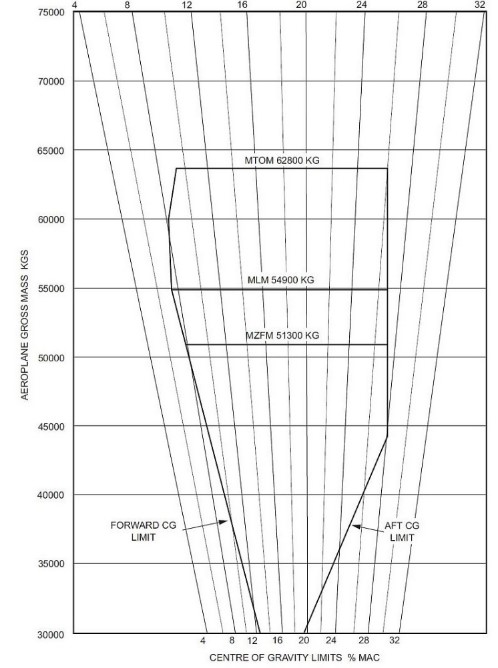
Assuming Maximum Structural Landing Mass (MSLM), what CG locations (in % MAC) have to be considered as the front and aft CG positions?
Question ID: 101382
A flight has been made from London to Valencia carrying minimum fuel and Maximum Traffic Load.
On the return flight the fuel tanks in the aeroplane are to be filled to capacity with a total fuel load of 20 100 liters at a fuel density of 0.79 kg/l.
The following are the aeroplane structural limits:
Maximum Ramp Mass: 69900 kg
Maximum Take-off Mass: 69300 kg
Maximum Landing Mass: 58900 kg
Maximum Zero Fuel Mass: 52740 kg
Performance limited Take-off Mass at Valencia: 67330 kg
Dry Operating Mass: 34930 kg
Trip Fuel (Valencia to London): 5990 kg
Taxi Fuel: 250 kg
Landing Mass at London is not performance limited. The maximum Traffic Load (TL) that can be carried from Valencia will be?
Question ID: 101383
A revenue flight is to be made by a jet transport. The following are the aeroplane structural limits:
Maximum Ramp Mass: 69900 kg
Maximum Take-off Mass: 69300 kg
Maximum Landing Mass: 58900 kg
Maximum Zero Fuel Mass: 52740 kg
Dry Operating Mass: 34930 kg
Trip Fuel: 11500 kg
Taxi Fuel: 250 kg
Contingency and Final Reserve Fuel: 1450 kg
Alternate Fuel: 1350 kg
Take-off and Landing Mass are not performance limited. The maximum Traffic Load (TL) that can be carried is?
Maximum Ramp Mass: 69900 kg
Maximum Take-off Mass: 69300 kg
Maximum Landing Mass: 58900 kg
Maximum Zero Fuel Mass: 52740 kg
Dry Operating Mass: 34930 kg
Trip Fuel: 11500 kg
Taxi Fuel: 250 kg
Contingency and Final Reserve Fuel: 1450 kg
Alternate Fuel: 1350 kg
Take-off and Landing Mass are not performance limited. The maximum Traffic Load (TL) that can be carried is?
Question ID: 101482
The planned Take-off Mass of a turbojet aeroplane is 180 000 kg, with its center of gravity located at 26% MAC (Mean Aerodynamic Chord)Shortly prior to engine start, the local staff informs the flight crew that 4 000 kg must be unloaded from cargo 4 (23.69 m aft of reference point)Given Distance from reference point to leading edge14m Length of MAC4.6m
After the handling operation, the new center of gravity location in % MAC will be?
After the handling operation, the new center of gravity location in % MAC will be?
Question ID: 101207
What is the principle of the index method?
Question ID: 101527
Given the following information for a Commercial Air Transport operation, calculate the maximum possible Extra Fuel to be uplifted?
Maximum Zero Fuel Mass (MZFM) 2000 kg
Actual Zero Fuel Mass (AZFM) 2000 kg
Regulated Take-Off Mass (RTOM) 2900 kg
Maximum Landing Mass (MLM) 2600 kg
Fuel Tank Capacity 950 kg
Trip Fuel (TF) 350 kg
Minimum Block Fuel (BF) 500 kg
Maximum Zero Fuel Mass (MZFM) 2000 kg
Actual Zero Fuel Mass (AZFM) 2000 kg
Regulated Take-Off Mass (RTOM) 2900 kg
Maximum Landing Mass (MLM) 2600 kg
Fuel Tank Capacity 950 kg
Trip Fuel (TF) 350 kg
Minimum Block Fuel (BF) 500 kg
Question ID: 101512
An aircraft has a mass of 5000 lbs and the CG is located at 80 inches aft of the datum. The aft CG limit is at 80.5 inches aft of the datum.
What is the maximum mass that can be loaded into a hold situated 150 inches aft of the datum without exceeding the limit?
Question ID: 101420
Given:
Dry Operating mass 85000kg
Performance Limited Take-off Mass 127000kg
Performance Limited Landing Mass 98500kg
Maximum Zero Fuel Mass 89800kg
Fuel requirements for flight:
Trip Fuel 29300kg
Contingency and final reserve fuel 3600kg
Alternate Fuel 2800kg
The maximum Traffic Load (TL) that can be carried on this flight is?
Dry Operating mass 85000kg
Performance Limited Take-off Mass 127000kg
Performance Limited Landing Mass 98500kg
Maximum Zero Fuel Mass 89800kg
Trip Fuel 29300kg
Contingency and final reserve fuel 3600kg
Alternate Fuel 2800kg
Question ID: 101215
Longitudinal CG location is normally expressed?
Question ID: 101468
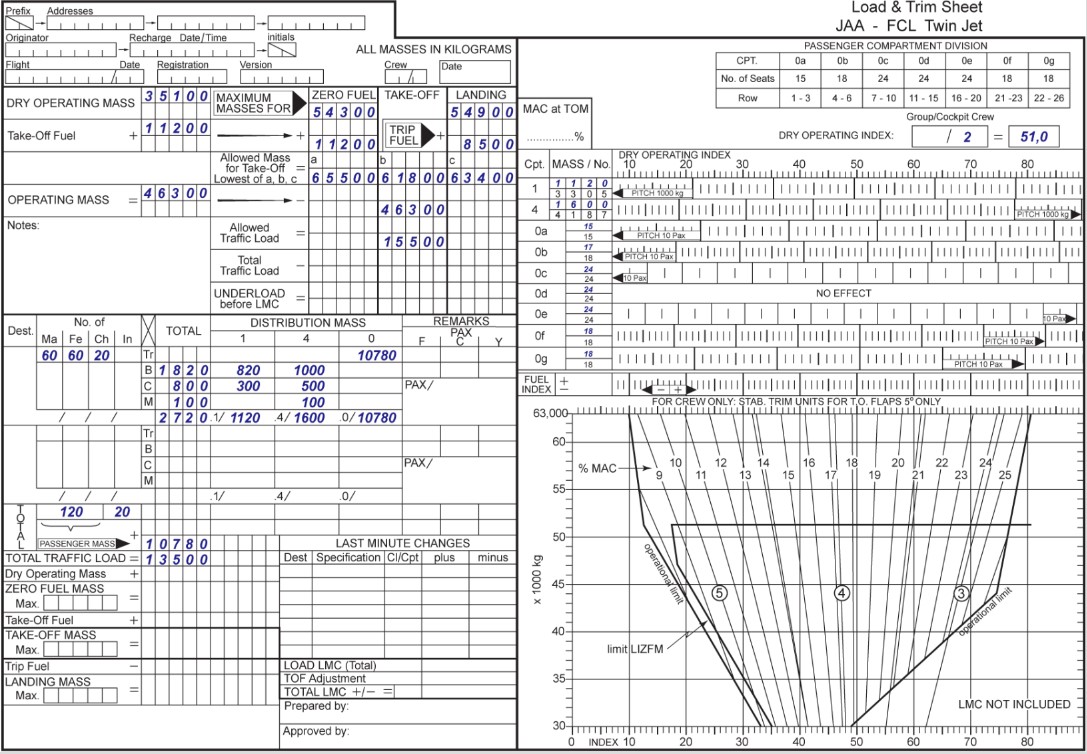
Refer to figure:
From the data given at the appendix and assuming a fuel index shift of -5.7 from the ZFM loaded index, determine which of the following, is the correct value (percentage MAC) for the position of the center of gravity at Take-off Mass?
Question ID: 101511
An aircraft has three holds situated 10 inches, 100 inches and 250 inches aft of the datum, identified as holds A, B and C respectively.
The total aircraft mass is 3500 kg and the CG is 70 inches aft of the datum.
The CG limits are from 40 inches to 70 inches aft of the datum.
How much load must be removed from hold C to ensure that the CG is positioned on the forward limit?
Question ID: 101469
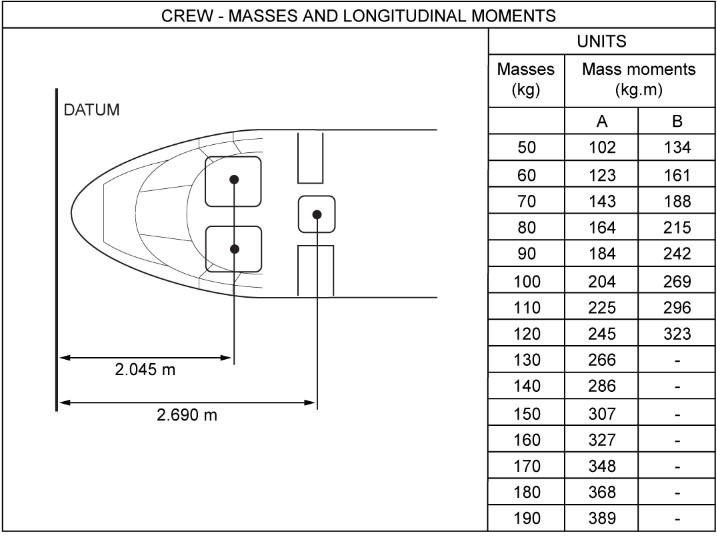
Without the crew, the mass and longitudinal CG position of the aircraft are 6 000 kg and 4.70 m?
The mass of the pilot 90kg
The mass of the copilot 100kg
The mass of the flight engineer 80kg
With the crew, the mass and longitudinal CG position of the aircraft are?
The mass of the pilot 90kg
Question ID: 101200
If nose wheel moves aft during gear retraction, how will this movement affect the location of the center of gravity (cg) on the aircraft?
Question ID: 101328
Given the following information, what is the maximum amount of Extra Fuel that can be uploaded for this Commercial Air Transport flight?
MTOM 2150 lb
MLM 2030 lb
ZFM 1803 lb
Planned T/O Fuel 35 US gal
Trip Fuel 27 US gal
Fuel tank capacity 68 US gal
Specific gravity 0.72
Question ID: 101514
If the CG is located at 670 inches, what would be its position as a percentage of the MAC, given the following characteristics of an aircraft? Leading Edge MAC 627.1 inches Length of MAC 155.8 inches
Question ID: 101559
An aircraft Dry Operating Mass is 3 000 kg The Maximum Take-off, Landing, and Zero-fuel Mass are identical, at 5 200 kg Ramp Fuel is 650 kg The Taxi Fuel is 50 kg The Traffic Load available is?
Question ID: 101485
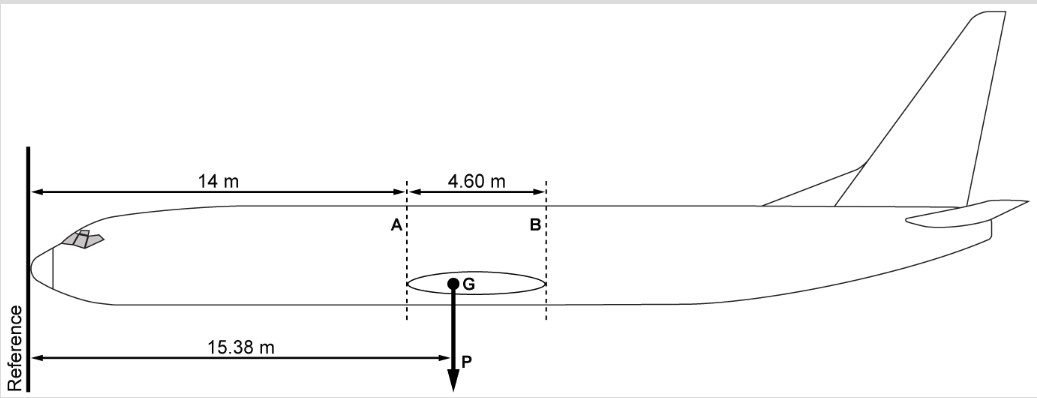
An aeroplane, whose specific data is shown in the question image, has a planned take-off mass of 200 000 kg. with its center of gravity (C.G.) is located at 15.38 m rearward of the reference point, representing a C.G. location at 30% MAC (Mean aerodynamic Cord).
For performance purposes, the captain decides to reset the value of the center of gravity location to 35% MAC. The front and rear cargo compartments are located at a distance of 15 m and 25 m from the reference point respectively, the cargo load mass which needs to be transferred from the front to the rear cargo compartment is?
Question ID: 101580
The CG limits of an aircraft are from 83 inches to 93 inches aft of the datum. The CG as loaded is found to be at 81 inches aft of the datum.
The loaded mass is 3240 lbs. How much mass must be moved from the forward hold, 25 inches aft of the datum, to the aft hold, 142 inches aft of the datum, to bring the CG onto the forward limit?
Question ID: 101384
Why do cargo loads need to be tied down?
Question ID: 101342
The Maximum Zero Fuel Mass is?
Question ID: 101586
An aircraft has a total mass of 5430 kgs with a CG of 5.43m aft of the datum line. Minutes before dispatch an additional load of 210kgs was loaded onto the aircraft. The aircraft's new CG is 5.56m aft of the datum.
The additional load was placed?
Question ID: 101504
Determine the maximum fuel load that can be carried in the following conditions?
Dry Operating Mass 2800 kg
Trip Fuel 300 kg
Traffic Load 400 kg
Maximum Take-off Mass 4200 kg
Maximum Landing Mass 3700 kg
Question ID: 101394
Due to a mistake in the load sheet the aeroplane is 1000 kg heavier than you believe it to be As a consequence?
Question ID: 101201
Given the following aircraft weighing data, determine the CG position:
Mass on nose gear: 435 kg
Mass on right main gear: 2 385 kg
Mass on left main gear: 2415 kg
Distance between nose and main gear: 583 cm
Question ID: 101571
Calculate the maximum mass that can be loaded on a pallet sized 1.2 mx 1.2 m, to comply with a maximum running load of 1915 kg/m?
Question ID: 101470
The Total Mass of an aeroplane is 9 000 kg.
The center of gravity (CG) position is at 2.0 m from the datum line.
The aft limit for CG is at 2.1 m from the datum line.
What mass of cargo must be shifted from the front cargo hold (at 0.8 m from the datum) to the aft hold (at 3.8 m), to move the CG to the aft limit?
Question ID: 101182
Refer to the diagram.
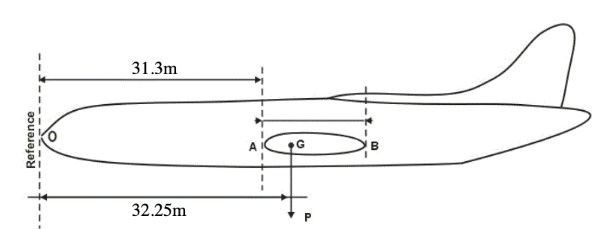
Given 13% MAC is located 32.25m aft of the reference datum, calculate the length of the chord?