Question ID: 103906
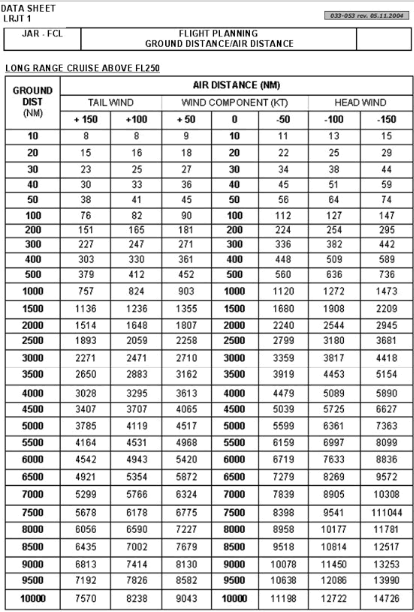
For a long-distance flight at FL 390, 'Long Range' regime, divided into four flight legs with the following characteristics segment AB?
Ground distance 2000 NM, head wind component 50 kt
segment BC?
Ground distance 1000 NM, head wind component 30 kt
segment CD?
Ground distance 500 NM, tail wind component 100 kt
segment DE?
Ground distance 1000 NM, head wind component 70 kt
The air distance of the entire?
Question ID: 103923
Using E-LO 2 What is the Frequency of aeronautical service when overflying? TULIP:
Question ID: 118130
An aircraft is flying a route from position A to B, a distance of 57 Nautical Ground Miles (NGM). Given the following information: True Airspeed (TAS): 145 kt Forecast wind: 240°/30 kt Course: 205° (M) Variation: 15°.
What is the distance covered in Nautical Air Miles (NAM)?
Question ID: 103945
What is the difference between an RNAV STAR and RNAV STAR overlay?
Question ID: 119799
Given the following information, at what distance should the pilot commence the descent in order to arrive overhead the airfield at 2000 ft?
Cruise level: FL95
GS: 155 kt
TAS: constant
Wind component: negligible
Temperature: ISA
QNH: 1030 hPa
Rate of descent: 500 ft/min
Question ID: 104751
In Commercial Air Transport operations, the purpose of Contingency Fuel is to?
Question ID: 103849
When completing an ATC flight plan for a flight commencing under IFR but possibly changing to VFR, the letters entered in Item 8 (FLIGHT RULES) would be?
Question ID: 103932
An aeroplane with reciprocating engines is planning to depart for an isolated destination aerodrome, as a Commercial Air Transport operation. Calculate the minimum amount of fuel required when overhead the isolated aerodrome, considering the following details?
Flight time: 2 hours and 45 minutes
Top of climb to top of descent time: 2 hours
Normal fuel consumption at cruise: 600 kg per hour
Question ID: 104800
Use the following information to calculate the total amount of fuel required for a Commercial Air Transport flight in a Medium Range Jet Transport MRJT aeroplane, with no destination alternate?
APU fuel flow: 115 kg/h
Taxi Fuel: 11 kg per minute
Planned APU usage at the parking position: 15 minutes
Planned taxi time: 15 minutes at both departure and destination aerodromes
Total trip distance: 315 NM
Average fuel flow: 2878 kg/h
TAS: 440 kt
Average headwind component: 16 kt
Contingency Fuel: 5 minutes Holding Fuel Holding fuel flow: 2200 kg/h
Answer in KG
Question ID: 104471
Determine the Take-off Mass (TOM) for the following single engine aeroplane.
Given Basic Empty Mass 1764 lbs Optional Equipment 35 lbs Pilot + Front seat passenger 300 lbs Cargo Mass 350 lbs Take-off Fuel 60 Gal Trip Fuel 35 Gal Fuel density 6 lbs/Gal
Question ID: 119741
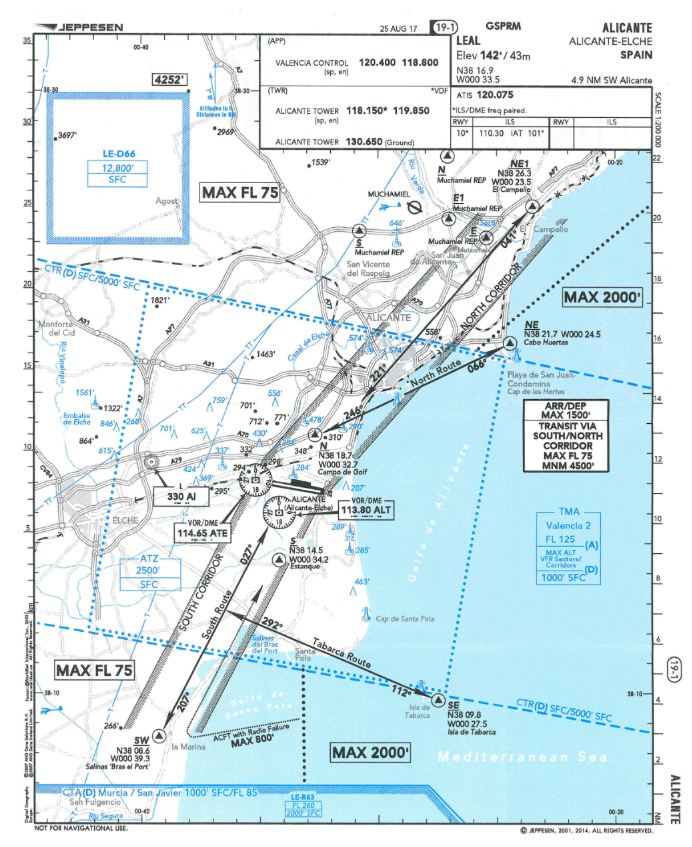
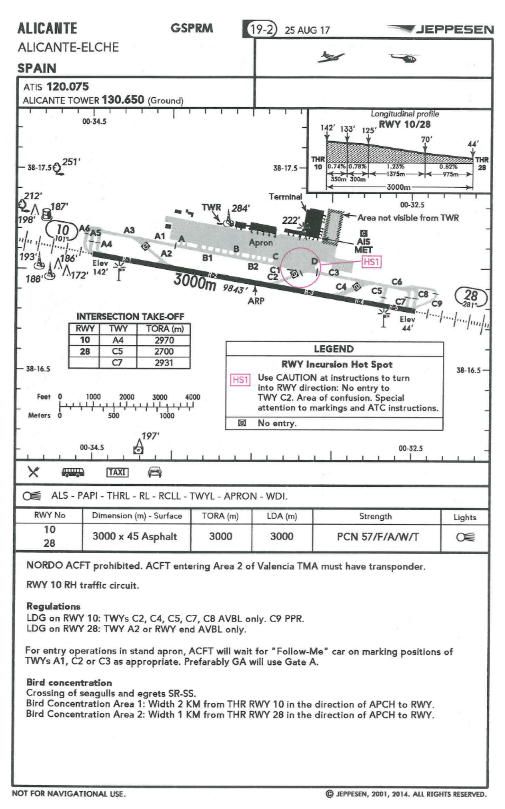
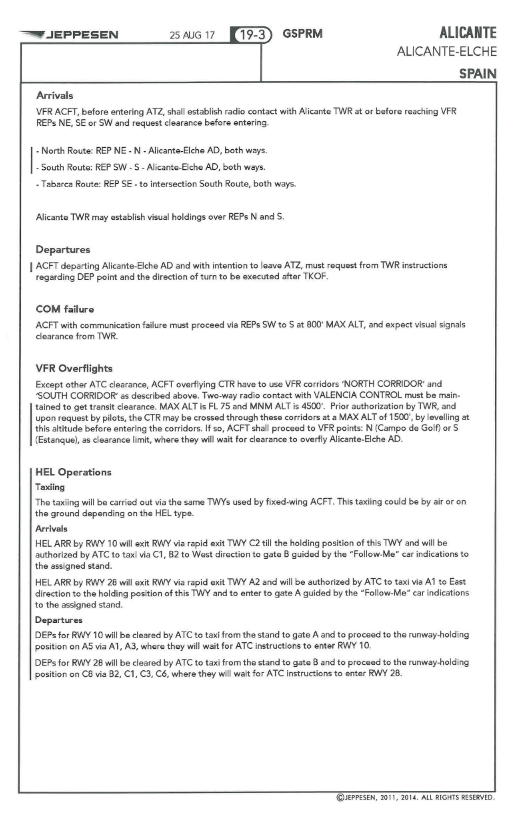
Refer to ALICANTE - charts 19-1, 19-2 and 19-3 from Jeppesen GSPRM 2017.
What is the elevation of the highest obstacle on the chart?
Question ID: 104190
RPLs (Repetitive Flight Plans) are used for flights with which of the following properties?
Question ID: 114219
An aircraft flies a planned heading of 040* according to the forecast wind of 160° T40 kt.
If the aircraft finally experiences in-flight a wind of 100*(T40 kt, which of the following statements is correct?
Question ID: 104712
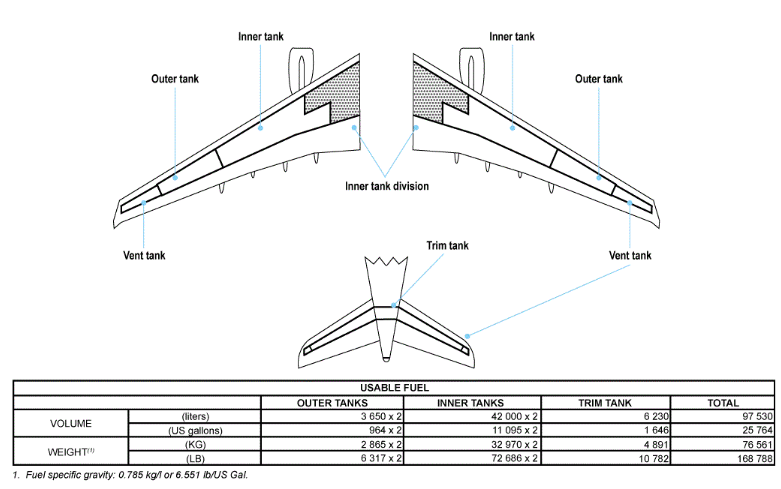
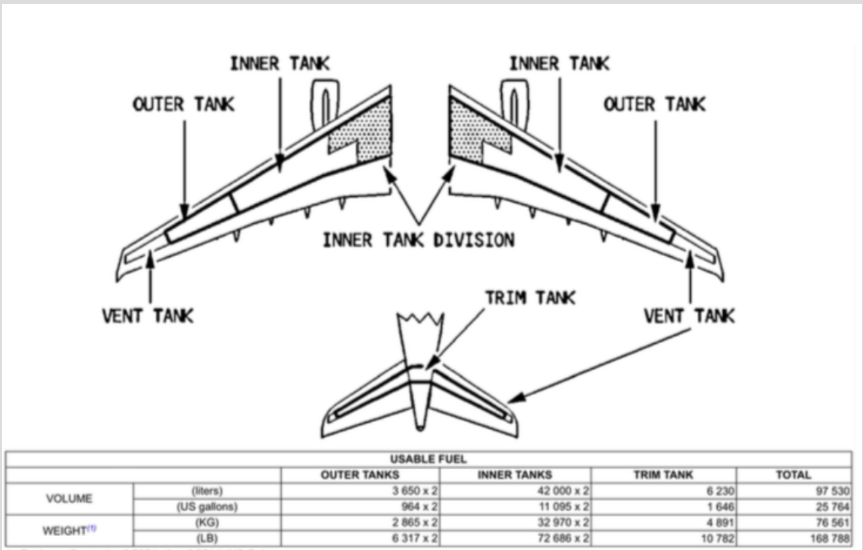
The engines always feed from each individual inner tank (left engine from left tank and right engine from right tank).
The trim tank transfer all content to the inner tanks when the inner tanks have less than 4000kg.
The outer tanks transfer all content to the inner tanks when the inner tanks have less than 3500 kg.
The fuel state of the aeroplane is as follows:
Trim tank: Full.
Outer tanks: Full.
During the flight, the trim tank transfer pump fail when the total fuel on board is 18620 kg. What is the Remaining endurance if the aeroplane fuel consumption is 96 kg/min?
Question ID: 103958
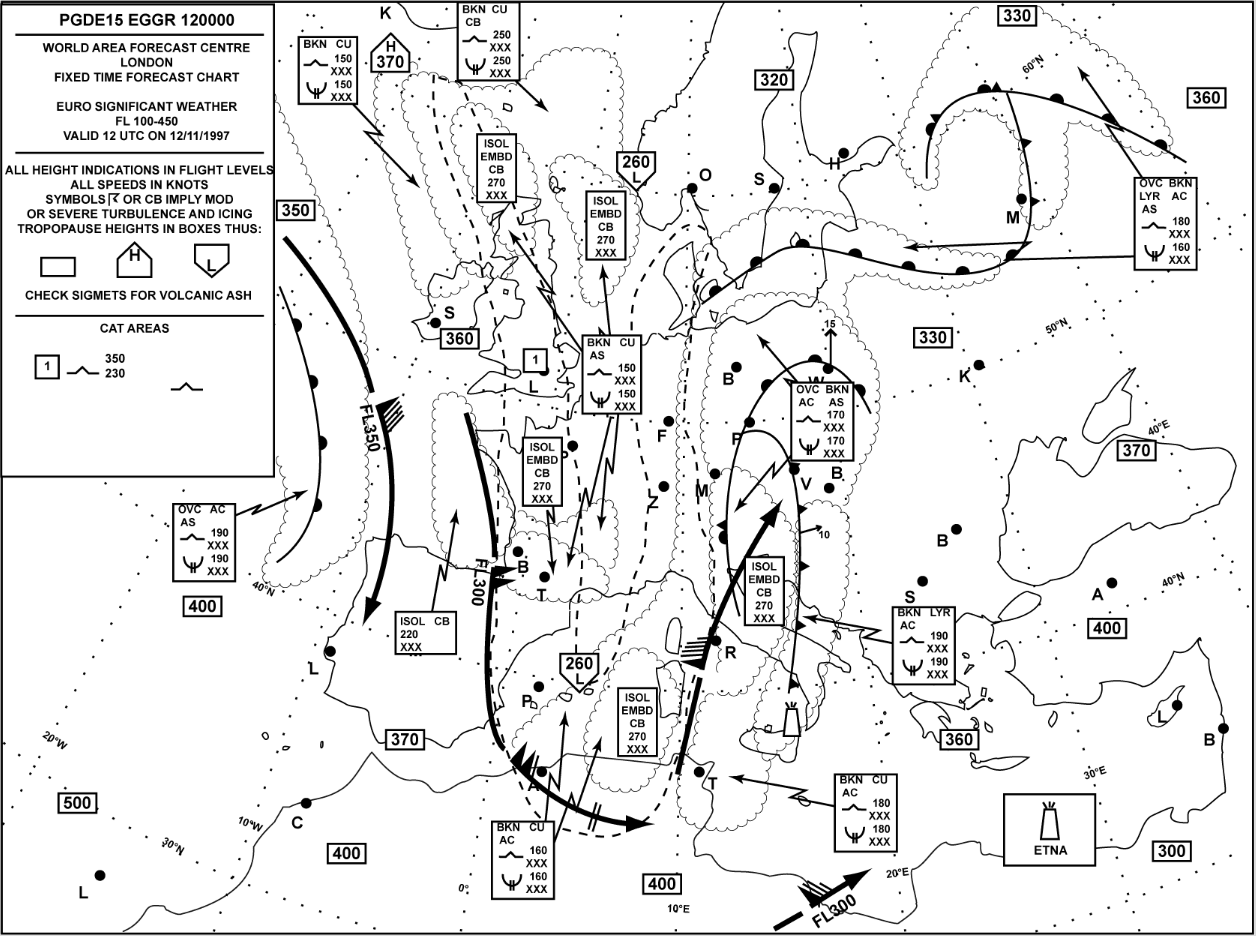
The maximum wind velocity (*/kts) immediately north of TUNIS (36° N 010" E) is?
Question ID: 104103
Refer to GSPRM-VFR Chart ED-4.
Find the magnetic course for a flight from Germany to Czech Republic?
Departure airfield is REGENSBURG (EDNR, N49° 08.52' E012 04.92') and destination airfield is STRUNKOVICE (LKSR, N49*4.95’E14*4.55').
Question ID: 103913
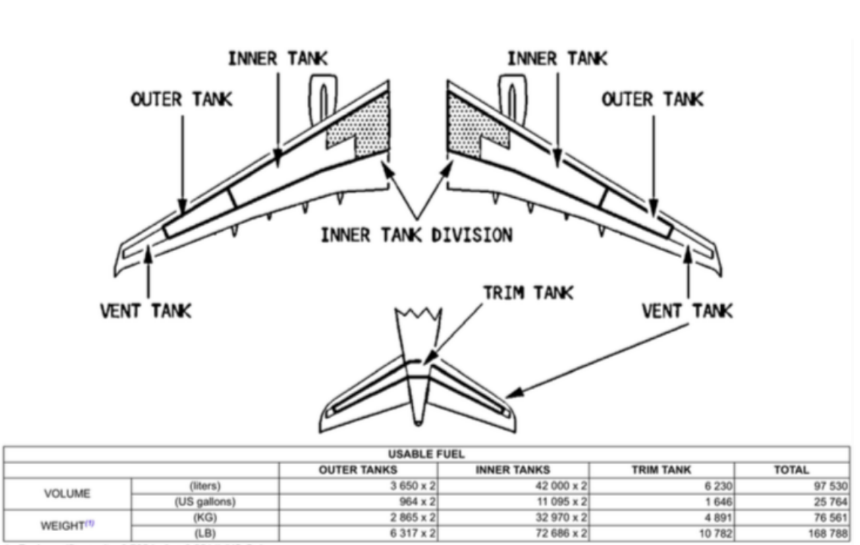
The engines always feed from each individual inner tank (left engine from left tank and right engine from right tank)?
When the inner tanks have 4000 kg fuel in them the trim tack transfer all its content evenly between the two inner tanks.
When the inner tanks have less than 3500 kg the outer tanks transfer all their content into their respective inner tank via transfer valves.
During flight when the fuel quantity reaches 12730 kg the left-hand transfer valve between the left outer and inner tanks fail to open.
What is the remaining endurance for the right engine if the fuel flow is 5420 kg/h?
Question ID: 104697
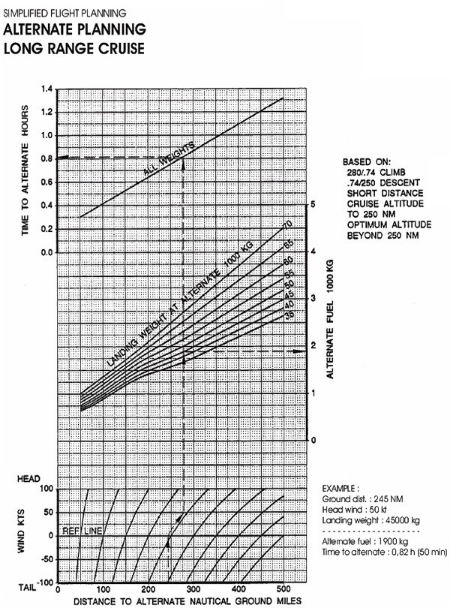
Using Flight Planning Manual MRJT 1 Figure 4.3.6 In order to get alternate fuel and time, the twin-jet aeroplane operations manual graph shall be entered with?
Question ID: 119733
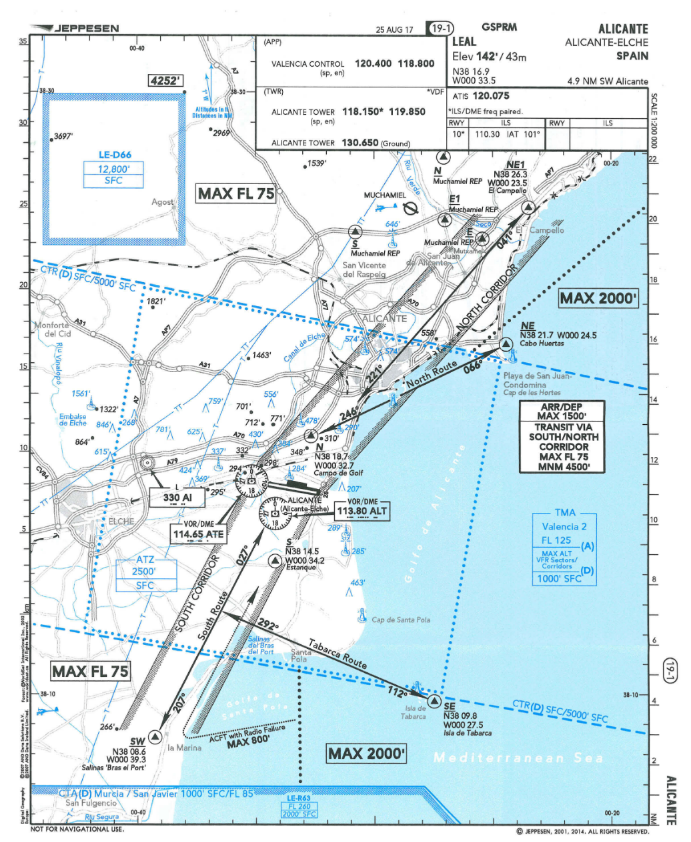
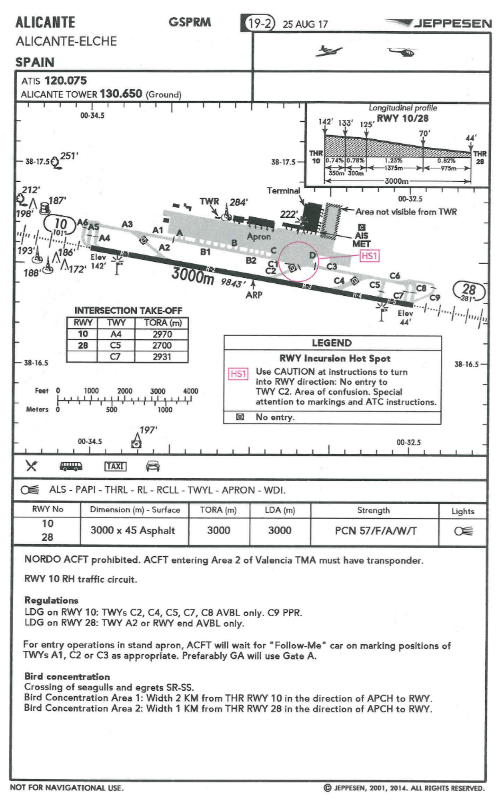
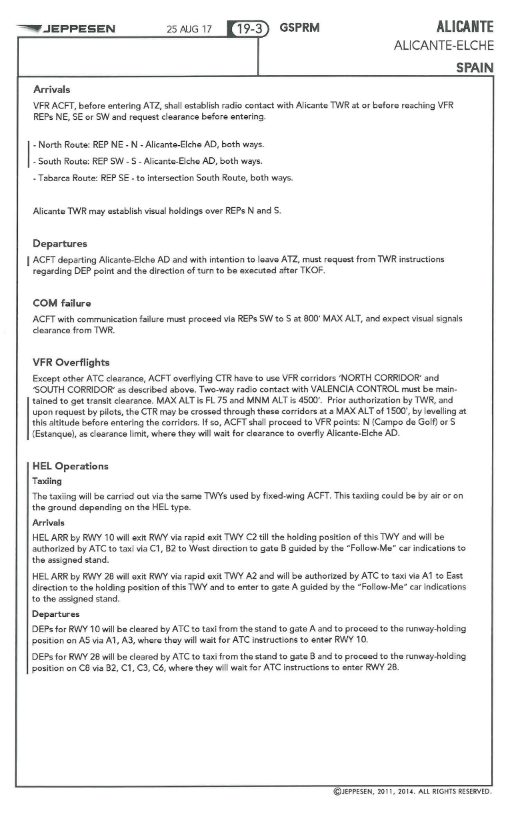
Refer to ALICANTE - charts 19-1, 19-2 and 19-3 from Jeppesen GSPRM 2017.
A VFR flight intends to land at Alicante Aerodrome (LEAL). The aircraft is currently overhead VFR report point SE, following the Tabarca route to intercept the South Route. The pilot expects delays, as the airport is busy with IFR arrivals and departures.
Where might the pilot be expected to hold?
Question ID: 113854
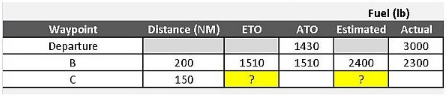
Given the following information, what will be the Estimated Time of Overflight (ETO) and estimated remaining fuel at waypoint C?
Question ID: 104090
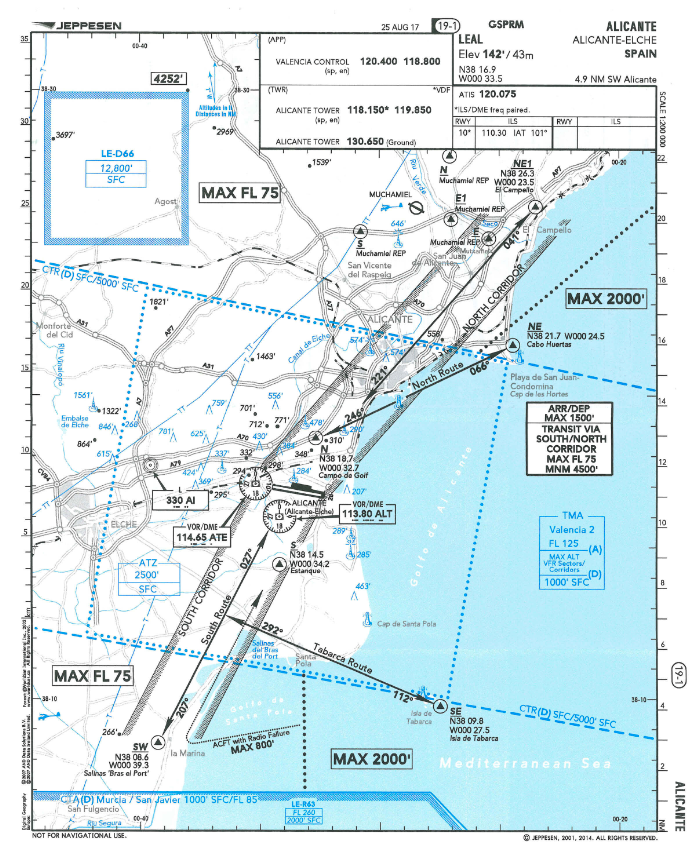
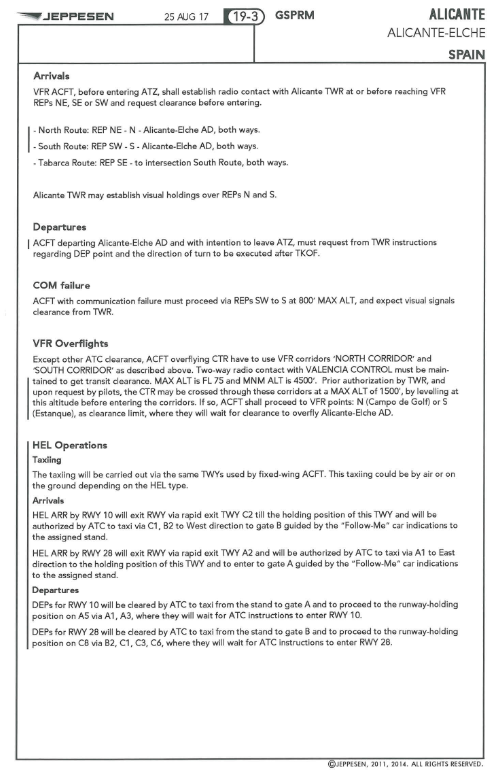
Refer to GSPRM Jeppesen VFR Plates ALICANTE 19-1 and 19-3.
You are approaching from the SW, VFR along the coast to recover to land;
What is the latest time you contact Alicante TWR?
Question ID: 103943
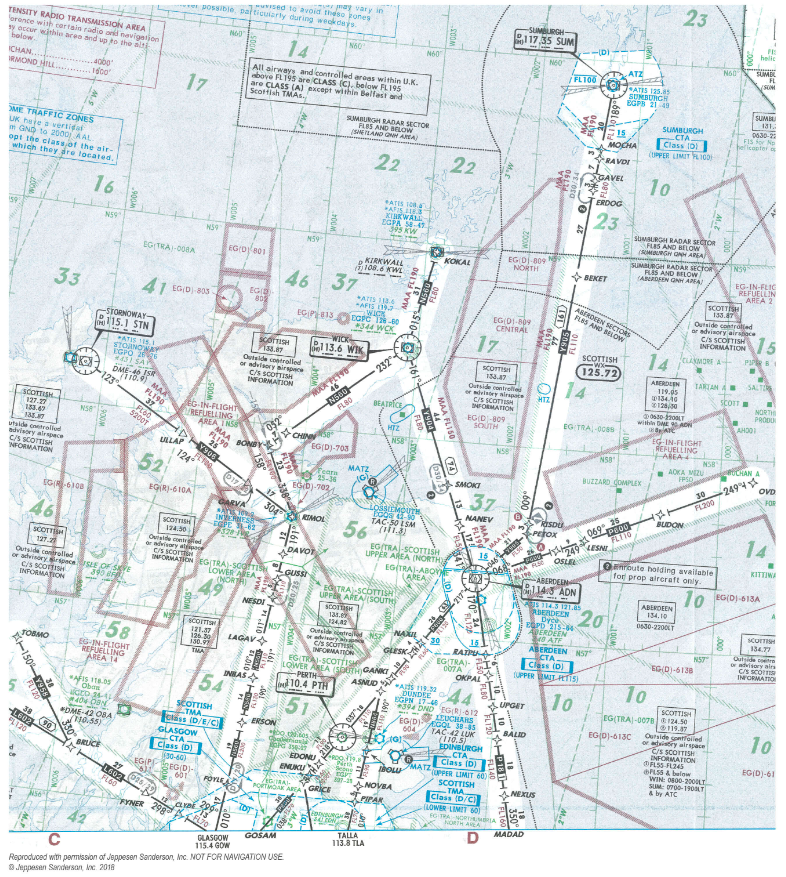
Refer to E LO 1
An aircraft is following the route Y906, approaching overhead position RIMOL (N57,33, w004*,03). Using the below, what WCA is needed to follow the route N560 southbound towards Glasgow VOR(GOW)?
MH 118
W/V 338"/45kts
Tas 200 kt
Question ID: 104387
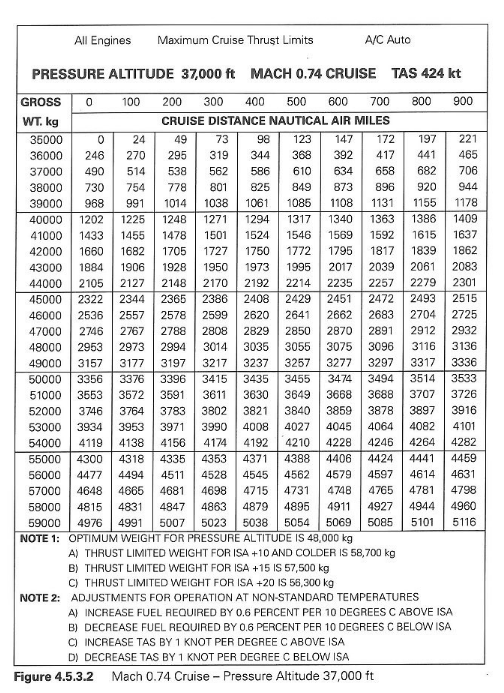
What will be the approximate change in air distance available from 1000 kg of fuel for the following situation if the tailwind component increases from 45 kt to 65 kt?
Aircraft mass at start of cruise leg 50000 kg
Cruise level FL370
Cruise speed Mach 0.74
Question ID: 104098
NANTES-Charts 19-1, 19-2, 19-3 from Jeppesen GSPRM 2017. On a VFR flight, you need to transit around Nantes airport. Who shall you contact to inform about your intentions?
Question ID: 104180
In the appropriate box of a flight plan, for endurance, one must indicate the time corresponding to?
Question ID: 103854
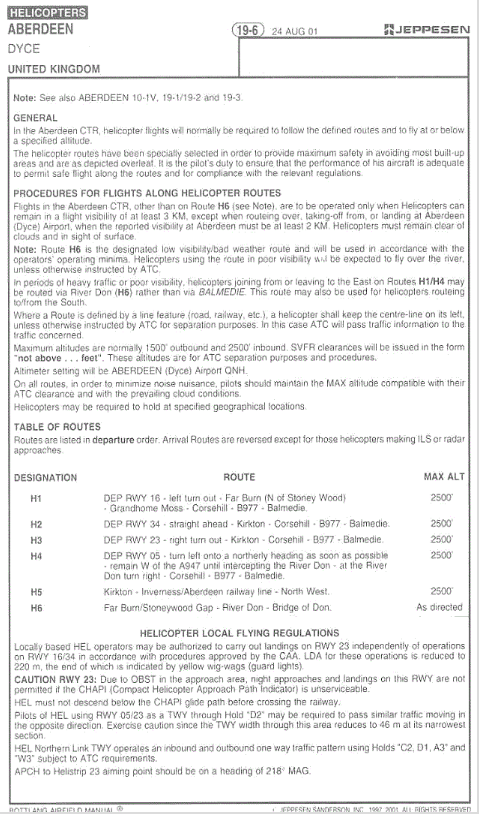
Using Aberdeen (Dyce) Information Page (19-6). What is the designated departure route when using Runway 23 in bad weather and/or low visibility?
Question ID: 103921
Using the Manual - Alicante - Charts 13-2,10-2J. An aircraft is flying on airway A34 to Alicante and arrives at MAGAL for an approach on runway 10. What distance from the IAF to the runway threshold?
Question ID: 104715
The aeroplane uses fuel in the following order:
Each engine feeds from the inner tank of the wing (Left engine feeds from Left Inner Tank; Right Engine from Right Inner Tank) When the inner tanks have 4000 Kg then the Trim Tank transfers all its contents equally to the Inner Tanks. When the Inner Tanks have 3500 Kg then the Outer tanks transfer their contents to the Inner Tanks via Transfer Valves.
Fuel state: Outer Tanks FULL Trim Tank FULL
During the flight the Trim Tank transfer pump fails when the total fuel on board is 18620 Kg
What is the Aeroplanes Total Endurance if the fuel consumption is 96 Kg/Min?