Question ID: 111874
What are the effects of using a clearway on both the Allowed Take-Off Mass and the associated V1.
The Allowed Take-Off Mass?
Question ID: 107494
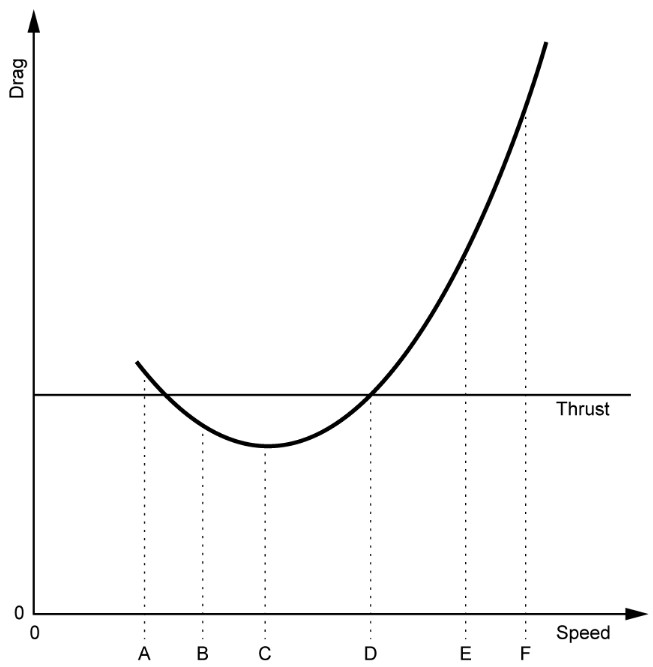
The speed VSR is defined as?
Question ID: 111890
Which statement is correct?
Question ID: 107431
What determines the maximum flight altitude in the Buffet Onset Boundary graph?
Question ID: 107625
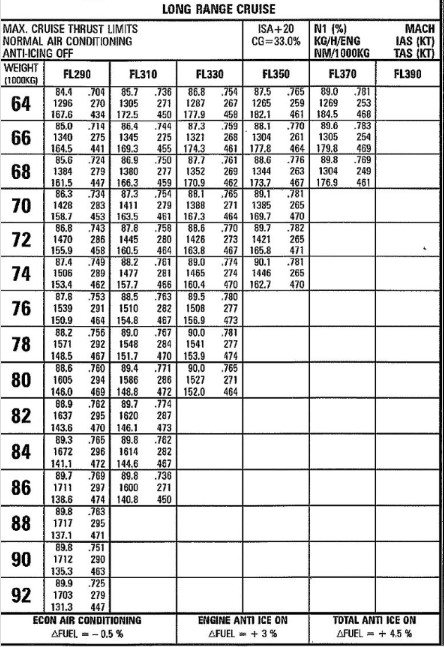
Refer to the image:
A twin engine aeroplane with data provided in the annex is flying for Long Range Cruise LRC at FL340 and in ISA +20° C conditions.
Find the N1, Mach number and fuel consumption if the aeroplane mass is 71000 kg and the CG is at 33% MAC.
Question ID: 111112
Given:
Still air gradient of climb: 5%
TAS: 250 kts
G/S: 200 kts
What is climb rate?
Question ID: 107376
On a segment of the take-off flight path an obstacle requires a minimum gradient of climb of 2.6% in order to provide an adequate margin of safe clearance at a mass of 110000 kg the gradient of climb is 2.8%
For the same power and assuming that the sine of the angle of climb varies inversely with mass, at what maximum mass will the aeroplane be able to achieve the minimum gradient?
Question ID: 111099
What is the minimum width of a clearway?
Question ID: 107428
Having all other conditions the same, taking off from an upward-sloping runway compared to a zero slope runway will result in?
Question ID: 107593
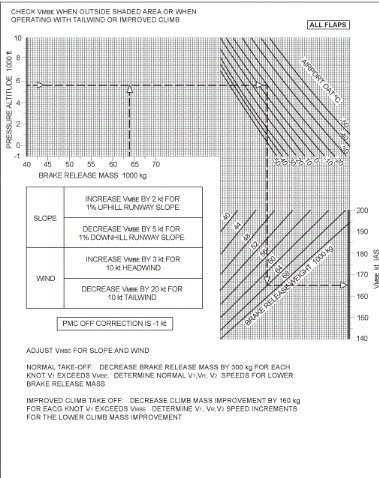
Using Annex or CAP 698 Fig 4.7
Determine VMBE?
Given:
TOM 60000 kg
PA 6000 ft
OAT-10°C
Slope 2% down,
5 kts TW,
PMC OFF.
Question ID: 110983
Which take-off condition is most likely resulting in the poorest climb performance?
Question ID: 107337
A Class B light twin aeroplane is to take-off on a Commercial Air Transport flight from an airfield with data as given below. What is the de-factored take-off distance that should be used to determine the maximum take-off mass from the gross-take-off performance graph produced for a level, paved and dry runway?
TORA 1270 ft
Clearway 385 ft
Stop way 215 ft
Upslope 1.3% (5% extra distance required for every 1 % of upslope)
Runway surface paved and wet
Question ID: 107645
A flight benefits from a strong tailwind which was not forecasted.
On arrival at the destination a straight-in approach and immediate landing clearance is given.
The Landing Mass will be higher than planned and?
Question ID: 111979
On a transatlantic flight, the captain asks the First Officer why a final step climb from FL340 to FL380 ten minutes before top of descent might not be an efficient use of the fuel. Select a possible explanation?
Question ID: 107944
An increase in ambient temperature causes the absolute ceiling to?
Question ID: 111880
A lower airspeed at constant mass and altitude requires?
Question ID: 107601
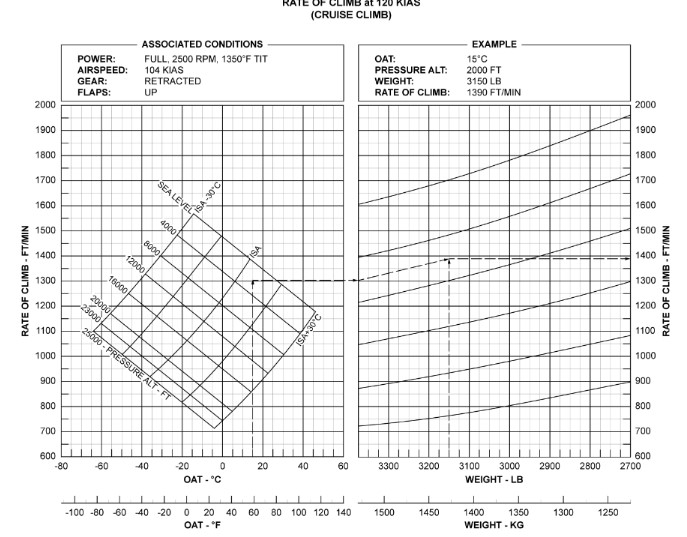
Given Climb power
Full throttle / 2500 RPM,
Altitude 6,500 ft,
Temperature ISA +15°C
QNH 1,030 hPa
Weight 1,250 kg
Find the rate of climb?
Question ID: 107363
For an instrument departure (SID). What is the procedure design gradient (PDG)?
Question ID: 111116
When compared to a clean configuration, how does flap setting usually affect the Runway Length Limited Take-Off Mass and the Climb Limited Take-Off Mass? The Runway Length Limited Take-Off Mass?
Question ID: 108127
Considering TAS for maximum range and maximum endurance, other factors remaining constant?
Question ID: 110120
What percentages of the headwind and tailwind components are taken into account when calculating the take-off field length required?
Question ID: 107408
What is the consequence of using a dry V1 on a wet runway for the Accelerate Stop Distance ASD?
Question ID: 107392
ON a contaminated runway, what happens to the CLTOM & FLTOM?
Question ID: 107453
What is likely to happen during take-off if a pilot uses a 'dry V1' in wet runway conditions?
Question ID: 107519
Refer to the attached figure and choose a correct statement below?